Machine Learning · Classification
Weather Predictor using Logistic Regression & SVM
A binary classification model that predicts whether it will rain based on historical weather data using Logistic Regression and Support Vector Machines.
Overview
This project seeks to answer an age old question > Will it rain tomorrow? Using real weather observations like temperature, humidity, and rainfall this notebook walks through preprocessing, training, evaluation, and model comparison between Logistic Regression and SVM.
The goal is to understand tradeoffs between a simple, interpretable linear model and a more flexible and complex SVM classifier.
Data & Methods
Dataset
- Historical daily weather observations (temperature, humidity, rainfall, etc.).
- Target label indicating whether it rained the following day.
Preprocessing
- Handled missing values and inconsistent entries.
- Removed featured with mostly absent values.
- Standardized/normalized numeric features using StandardScaler and dummy variables.
- Split into train and test sets.
Models
- Logistic Regression for a baseline linear classifier.
- Support Vector Machine (SVM) classifier with various kernel.
- Evaluated accuracy for each classifier and multiple SVM kernels.
Tech Stack
Python, scikit-learn, pandas, NumPy, matplotlib, Jupyter
Metrics
Support Vector Machine Classifier:
- Linear kernel accuracy: 84.5%
- RBF kernel accuracy: 85.3%
- Polynomial kernel accuracy: 84.0%
Logistic Regression Classifier:
- Accuracy: 84.5%
Key Charts
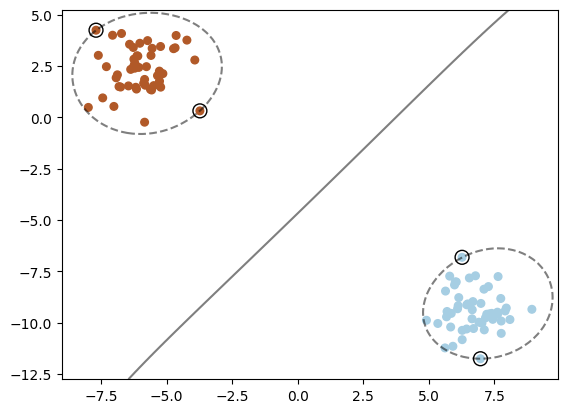
ROC curve can show us a general indication on how well the classifier is performing. SVM complexity makes it difficult to view true classification within multiple hyperplanes.
Analysis
-
All model accuracies are about equal with the RBF SVM kernel performing the best with 85.3%. I also
performed a GridSearchCV to find the optimal hyperparameters for the SVM classifier which returned
the exact parameters used in the RBF model training. Feature importance can also be explored to determine
what factors may be contributing to the overall classification.
Challenges & Learnings
- Handling noisy, real-world weather data with missing or inconsistent values.
- Comparing a simple linear model to a various SVM kernels in terms of both metrics and interpretability.
- Improvments to this project include exploring other classifiers, features, and adding more data to see if accuracy improves.